Brushed Wide Traditional Korean House: A Design Resource for Cultural Illustration
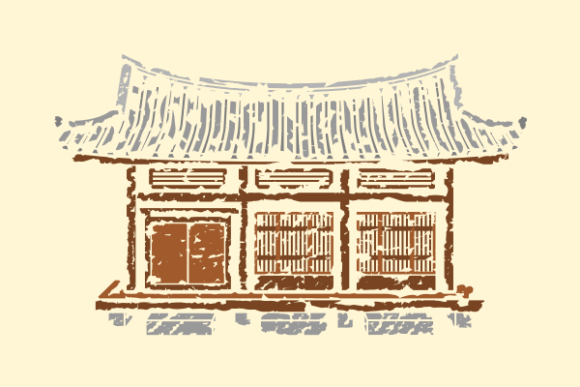
The integration of historical architecture into modern graphic design requires assets that balance authenticity with artistic flexibility. The Brushed Wide Traditional Korean House illustration serves as a distinct resource for designers working on projects related to Oriental history, cultural heritage, and educational materials. Unlike standard photographic stock or rigid vector outlines, this specific asset utilizes a brush stroke style to capture the essence of a Hanok while maintaining the scalability required for professional production. Understanding the unique characteristics of this format helps designers determine if it aligns with their project goals or if alternative approaches might be more suitable.
Defining the Brushed Style in Architectural Illustration
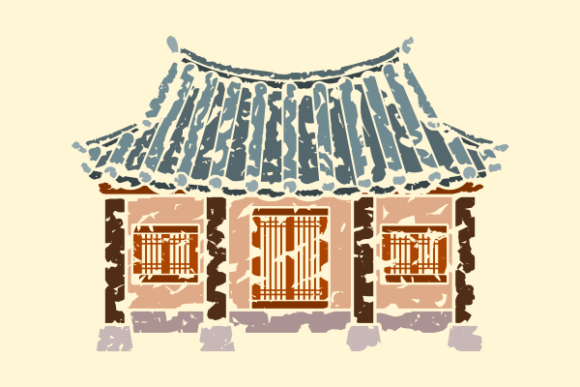
A Brushed Wide Traditional Korean House is not merely a drawing of a building; it is a stylistic interpretation that mimics the texture of ink wash painting or sumi-e. In traditional Korean art, the brush stroke conveys movement, atmosphere, and the organic nature of the subject. When applied to a wide front view of a Hanok, this technique softens the geometric rigidity of the structure, emphasizing the sweeping curves of the tiled roof (giwa) and the delicate joinery of the wooden pillars.
This style differs significantly from flat vector graphics or high-resolution photography. While a photograph captures every detail of weathering and material texture, it can sometimes feel too literal for conceptual designs. Conversely, a simple line art outline may lack the depth and mood necessary for evoking a sense of history. The brushed approach occupies a middle ground, offering an impressionistic quality that suggests the form of the house without overwhelming the viewer with photorealistic data. This makes it particularly effective for backgrounds, book covers, and cultural presentations where the architecture needs to set a scene rather than serve as the sole focal point.
Key Visual Characteristics
- Texture Variation: The use of simulated brush strokes creates a dynamic surface that adds visual interest without requiring complex shading techniques.
- Compositional Width: The "wide" aspect of the illustration ensures the entire facade is visible, capturing the symmetry and spatial arrangement typical of traditional Korean residential compounds.
- Cultural Nuance: Specific details, such as the eaves and the placement of doors, are rendered with enough fidelity to be recognizable as authentic Hanok structures.
Comparing Vector Formats and Editing Capabilities
When evaluating resources for architectural illustration, the file format and editing potential are critical decision factors. The Brushed Wide Traditional Korean House is provided as an editable SVG vector, which offers significant advantages over raster-based images like JPEGs or PNGs alone. However, understanding the tradeoffs between different vector formats and software tools is essential for maximizing the asset's utility.
SVG (Scalable Vector Graphics) files are resolution-independent, meaning they can be scaled to any size—from a small icon to a large billboard—without losing clarity. This is a primary benefit for designers who need a single asset to work across multiple media channels. In contrast, raster images degrade when enlarged, often resulting in pixelation that compromises professional quality. While the package also includes high-resolution PNGs for immediate use in web contexts, the SVG remains the core asset for print and large-format applications.
Software Compatibility and Workflow
While many vector editors exist, the recommendation to use Inkscape for editing this specific asset highlights the importance of open-source compatibility. Inkscape handles SVG paths efficiently and allows for granular control over individual brush strokes. This is crucial because the "brushed" effect is often constructed from layered paths that simulate ink flow. With Inkscape, a designer can modify the color palette, adjust the opacity of specific strokes, or even alter the shape of the roofline to fit a specific composition.
Designers accustomed to Adobe Illustrator will find the transition relatively smooth, as SVG is a universal standard. However, those relying solely on proprietary software should verify that the specific path structures used in the illustration do not rely on custom brushes exclusive to other ecosystems. The inclusion of EPS and PDF formats in the download package further broadens compatibility, ensuring that the asset can be integrated into workflows involving desktop publishing software like Adobe InDesign or QuarkXPress.
Evaluating Use Cases and Design Fit
Determining whether the Brushed Wide Traditional Korean House is the right choice depends heavily on the intended application. It excels in scenarios where the goal is to evoke a sense of tradition, history, or cultural identity without demanding strict architectural accuracy.
Ideal Applications
- Educational Materials: Textbooks and documentaries about Korean history benefit from the illustrative style, which simplifies complex structures for learners while retaining cultural markers.
- Tourism and Marketing: Brochures promoting cultural tourism can use the brushed style to create an inviting, artistic atmosphere that feels more curated than a generic stock photo.
- Event Branding: Festivals, exhibitions, or conferences celebrating Asian heritage can utilize the wide perspective to create banners and backdrops that establish an immersive environment.
- Editorial Design: Magazine articles discussing architecture, interior design trends inspired by minimalism, or travel features can use the illustration as a thematic element.
Limitations and Alternatives
Despite its versatility, this asset may not be suitable for every project. If a design requires precise architectural measurements, structural analysis, or photorealistic rendering, the brushed style is inappropriate. Similarly, if the target audience expects a hyper-modern or futuristic aesthetic, the traditional Hanok imagery might clash with the overall tone.
In situations requiring extreme customization of the building's geometry—for instance, adding new windows or changing the floor plan—a fully parametric 3D model or a CAD drawing would be a better alternative. The vector nature of the SVG allows for some modification, but fundamentally reshaping the building requires advanced vector manipulation skills and may disrupt the artistic integrity of the brush strokes. For projects needing a completely different architectural style, such as Japanese tea houses or Chinese pagodas, sourcing a dedicated asset for that specific culture is preferable to attempting to morph the Hanok illustration.
Decision Factors for Selecting Architectural Assets
When comparing the Brushed Wide Traditional Korean House against other available resources, several practical factors influence the final decision. These include the level of editing required, the desired visual weight, and the technical constraints of the output medium.
Editing Flexibility: If your workflow demands frequent changes to colors or minor adjustments to the silhouette, the editable SVG format is superior to static raster images. The ability to separate layers in Inkscape means you can isolate the roof, the walls, or the surrounding landscape elements independently. This modularity saves time compared to redrawing elements from scratch.
Visual Weight and Mood: Consider the emotional impact of the asset. A photographed Hanok carries a sense of documentary realism, which can feel heavy or serious. The brushed illustration, by contrast, feels lighter and more interpretive. For designs that aim to be elegant, poetic, or nostalgic, the illustrated approach often resonates better with the audience. It invites the viewer to imagine the space rather than simply observing it.
File Management and Delivery: The inclusion of multiple formats (SVG, EPS, PDF, PNG) in a single ZIP file addresses various delivery requirements. You can hand off the high-resolution PNG to a web developer while providing the EPS to a print vendor. This comprehensive package reduces the need for additional conversion steps, streamlining the production process. However, designers should ensure their team has access to software capable of opening these formats, particularly the vector files, to avoid bottlenecks.
Strategic Implementation in Modern Design
Incorporating a Brushed Wide Traditional Korean House into contemporary design requires a thoughtful approach to composition. Because the style is inherently artistic, it pairs well with clean typography and ample negative space. Overcrowding the illustration with text or competing graphical elements can diminish its impact.
Designers often use this type of asset as a background element, applying a slight transparency or blending mode to allow text to remain legible. Alternatively, the wide perspective allows for creative cropping; one might focus only on the intricate roofline for a header image or use the full width for a hero banner. The key is to respect the original artistic intent while adapting the asset to the specific layout constraints of the project.
Ultimately, the value of this resource lies in its ability to bridge the gap between historical authenticity and modern design needs. It provides a ready-made solution for representing Korean culture that is both visually engaging and technically robust. By understanding its strengths, limitations, and optimal use cases, designers can make informed decisions that enhance their projects with meaningful and culturally respectful imagery.