Cartoon Top View Trees, Plants, Bushes: A Strategic Asset for Landscape Design
In the realm of landscape architecture and urban planning, clarity is the currency of successful execution. Cartoon Top View Trees, Plants, Bushes are not merely decorative illustrations; they are critical communication tools that bridge the gap between abstract concepts and tangible reality. For professionals ranging from seasoned architects to small business owners managing property development, these visual assets serve as a universal language. They transform complex spatial data into digestible, actionable plans, ensuring that every stakeholder—from investors to ground crews—shares a unified vision of the final outcome.
The strategic value of utilizing high-quality vector sets containing garden tree, bush, shrub, and plant elements lies in their ability to standardize communication. When a project moves from the conceptual phase to the schematic design phase, ambiguity becomes a liability. By integrating Cartoon Top View Trees, Plants, Bushes into your workflow, you establish a consistent visual vocabulary. This consistency reduces errors during construction, minimizes costly revisions, and accelerates the approval process with clients who may lack technical training but possess a strong aesthetic intuition.
Defining the Role of Visual Assets in Planning
To understand why Cartoon Top View Trees, Plants, Bushes are indispensable, one must first recognize the limitations of traditional drafting methods. Hand-drawn sketches often suffer from inconsistency, while photorealistic renderings can be time-consuming and computationally expensive during early brainstorming sessions. The "cartoon" style, characterized by clean lines, simplified forms, and clear silhouettes, offers a middle ground. It strips away unnecessary detail to focus on the essential geometry of the landscape.
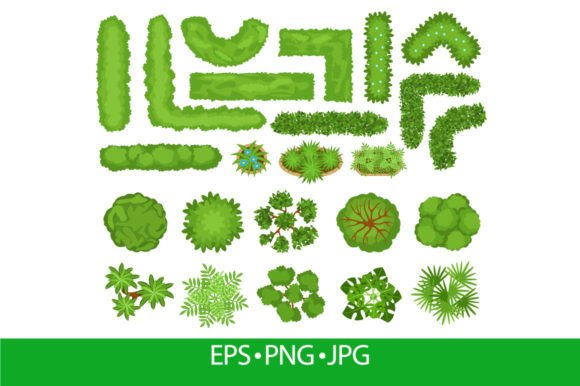
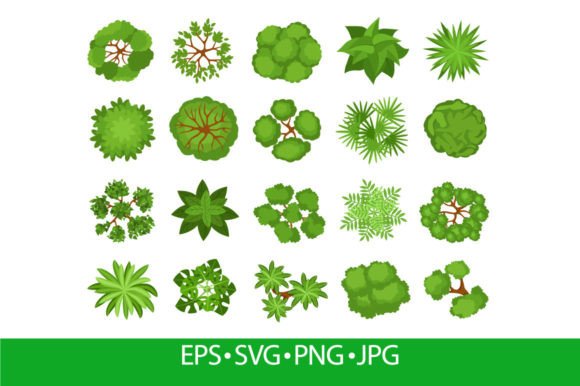
This approach allows designers to prioritize spatial relationships over texture. When you deploy a Garden tree, bush, shrub, plant elements for landscape plan vector set, you are effectively creating a map where the primary objective is to define zones, circulation paths, and planting densities. These assets enable rapid iteration. You can move a cluster of bushes or adjust the canopy spread of a tree in seconds, allowing for dynamic decision-making based on immediate feedback rather than waiting days for a new rendering.
Furthermore, the availability of these assets in multiple formats—EPS, SVG, PNG, and JPEG—ensures flexibility across different stages of a project. Vector formats like EPS and SVG are crucial for scaling without loss of quality, making them ideal for large-scale site plans and blueprints. Raster formats like PNG and JPEG are better suited for presentations, digital marketing materials, and client meetings where quick loading times and compatibility with presentation software are paramount.
Enhancing Communication and Client Engagement
One of the most significant challenges in landscape design is translating technical intent into client understanding. Clients often struggle to interpret contour lines or dense hatching on a blueprint. Cartoon Top View Trees, Plants, Bushes solve this by providing an intuitive visual representation. A stylized oak tree icon immediately conveys the concept of a mature shade provider, while a low-lying bush symbol suggests a border or screening element.
This visual shorthand fosters better decision-making. When a client sees a proposed layout populated with distinct plant symbols, they can more easily visualize the scale and impact of the greenery. This leads to more informed choices regarding species selection, placement, and maintenance requirements. Instead of debating abstract measurements, the conversation shifts to the experience of the space: "Does this cluster of trees provide enough privacy?" or "Will this row of bushes obstruct the view?"
For entrepreneurs and marketers in the landscaping sector, these visuals also play a pivotal role in branding and proposal creation. A polished, professional-looking site plan featuring well-curated plant elements signals competence and attention to detail. It elevates the perceived value of the service being offered, helping to secure contracts and build trust with potential customers.
Strategic Implementation in Different Project Phases
The utility of Cartoon Top View Trees, Plants, Bushes extends beyond the initial design phase. Their application varies depending on the specific goals of the project stage, requiring a thoughtful approach to selection and deployment.
- Conceptual Brainstorming: During the ideation phase, speed is essential. Use simplified icons to explore multiple layout options rapidly. Focus on massing and flow rather than botanical accuracy. This allows for creative freedom without getting bogged down in details.
- Schematic Design: As the plan matures, introduce more specific symbols from your vector set to differentiate between deciduous and evergreen species, or between ornamental shrubs and functional hedges. This level of detail helps in calculating rough quantities and estimating costs.
- Construction Documentation: While detailed CAD drawings are necessary for builders, overlaying Cartoon Top View Trees, Plants, Bushes can help clarify planting locations for non-specialist contractors. Clear symbols reduce the risk of misinterpretation on-site.
- Marketing and Presentation: For public-facing materials, leverage the aesthetic appeal of these graphics. Combine them with color-coded zones to create engaging maps that highlight key features of the landscape, such as walking trails, seating areas, and focal points.
When approaching these phases, it is vital to maintain a library of organized assets. A disorganized collection of images leads to inefficiency. Categorize your Different greenery for projects, maps and schemes by type (trees, shrubs, ground cover), form (round, conical, spreading), and function (shade, screening, accent). This organization ensures that you can retrieve the right asset at the right moment, maintaining momentum in your workflow.
Risks of Indiscriminate Usage
While the benefits are substantial, relying on Cartoon Top View Trees, Plants, Bushes without a clear strategy carries risks. The primary danger lies in oversimplification. If the visual style is too cartoonish or generic, it may undermine the credibility of the design, especially for high-end residential or commercial projects where precision is expected.
Another risk is the mismatch between the symbol and the actual plant. Using a symbol for a massive canopy tree when the budget only allows for a sapling can lead to unrealistic expectations. Similarly, placing dense bush symbols in an area intended for open lawn can confuse the spatial logic of the plan. It is crucial to ensure that the visual weight of the symbols corresponds accurately to the physical dimensions and growth habits of the proposed vegetation.
Furthermore, over-reliance on pre-made assets can stifle creativity. Designers might fall into the trap of arranging plants based on the available icons rather than the ecological needs of the site. Always remember that these tools are meant to support your design thinking, not dictate it. The biological reality of the site—soil conditions, sunlight exposure, water availability—must always take precedence over the convenience of a vector graphic.
Optimizing Workflow with Format Selection
A strategic approach to using Cartoon Top View Trees, Plants, Bushes involves selecting the appropriate file format for each task. Understanding the strengths of EPS, SVG, PNG, and JPEG formats ensures that your deliverables meet technical standards and performance requirements.
EPS (Encapsulated PostScript) and SVG (Scalable Vector Graphics) are the gold standards for design work. Because they are vector-based, they can be scaled infinitely without pixelation. This is essential for large-format printing, such as site banners or architectural blueprints. SVG is particularly valuable for web-based applications, allowing interactive maps where users can zoom in on specific planting areas without losing image quality.
PNG (Portable Network Graphics) supports transparency, making it ideal for layering plant elements over photographs or satellite imagery. This capability is useful for creating "before and after" visualizations or for overlaying proposed designs onto existing site photos. However, PNGs are raster-based, meaning they have a fixed resolution. If scaled up too much, they will appear blurry.
JPEG (Joint Photographic Experts Group) files are best used for final presentations where file size is a concern. They offer good compression, making them easy to email or embed in documents. However, they do not support transparency and can suffer from compression artifacts if edited repeatedly. Use JPEGs only for the final output, not for intermediate design steps.
Long-Term Value and Decision-Making
Investing time in curating and mastering the use of Cartoon Top View Trees, Plants, Bushes yields long-term dividends. It streamlines your operational efficiency, reduces the time spent on repetitive drafting tasks, and enhances the quality of your client interactions. By establishing a robust system for visual communication, you position yourself as a professional who values clarity and precision.
Moreover, these assets facilitate better learning and knowledge transfer within teams. Junior designers can quickly grasp the principles of landscape composition by studying how senior staff utilize these symbols to convey complex ideas. This shared visual language fosters collaboration and ensures that the firm's design standards are maintained across all projects.
Ultimately, the goal is not just to create pretty pictures but to drive better outcomes. Whether you are designing a corporate campus, a community park, or a private garden, the intentional use of Cartoon Top View Trees, Plants, Bushes empowers you to make informed decisions, communicate effectively, and deliver results that align with both aesthetic aspirations and practical constraints. By treating these visual tools as strategic assets rather than mere decorations, you elevate the entire design process, turning abstract plans into thriving, sustainable landscapes.