Mastering the Skyline: A Guide to Top View Trees, Plants, and Garden Bushes in Landscape Design
When we think about gardening or landscape architecture, our minds often drift to the vertical experience: the height of a towering oak, the cascading vines of a trellis, or the vibrant splash of flowers at eye level. However, there is a perspective that fundamentally changes how we understand spatial relationships, ecological planning, and aesthetic composition: the top-down view. Whether you are an experienced architect drafting a city park or a homeowner sketching a backyard oasis, understanding top view trees, plants, garden bushes, and hedges is essential for creating functional and beautiful outdoor spaces.
This guide explores the unique value of looking down on greenery, the role of vector sets in modern design, and how these botanical objects shape our environments from the ground up.
The Unique Perspective of the Bird's-Eye View
Why does the top-down perspective matter? In landscape design, the "plan view" is the foundation upon which all other decisions rest. While a side profile shows us the silhouette and texture of a plant, the top view reveals its footprint, density, and canopy spread. This perspective allows designers to visualize how different elements interact within a confined space without the obstruction of vertical layers.
For instance, a garden bush might look small from the side but possess a wide, sprawling root system and canopy that could overwhelm a narrow pathway. Conversely, a columnar tree might appear imposing vertically but occupy very little ground area, making it perfect for tight urban courtyards. By studying top view representations, designers can optimize spacing, ensure proper airflow, and prevent future overcrowding.
Understanding Canopy Spread and Density
One of the most critical aspects of top-view analysis is understanding canopy density. In a city park landscaping element plan, the difference between a deciduous tree with a loose canopy and an evergreen hedge with dense foliage drastically affects sunlight penetration and privacy. Top view illustrations allow planners to map out shade patterns throughout the seasons, ensuring that benches, play areas, and walking paths receive the appropriate amount of light.
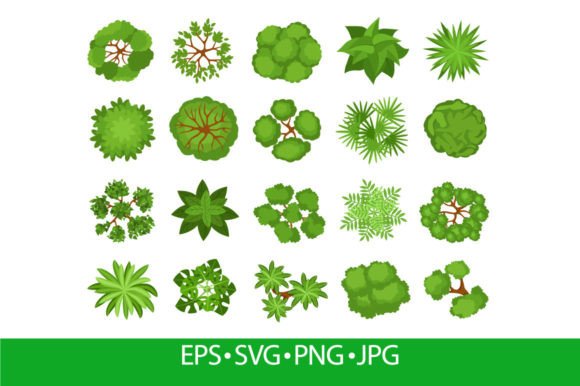
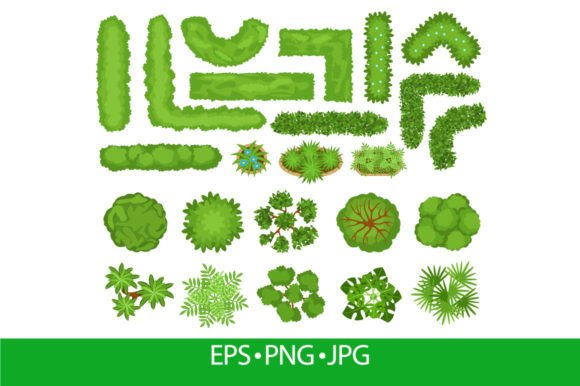
Furthermore, this perspective highlights the organic shapes of nature. Unlike geometric structures, plants grow in irregular, fluid forms. A collection of botanic objects with green foliage viewed from above showcases the natural asymmetry that brings life to a rigid architectural grid. This contrast between the man-made and the natural is where true landscape harmony is found.
The Role of Vector Sets in Modern Planning
In the digital age, the tools used to create these designs have evolved significantly. The demand for high-quality, scalable graphics has led to the creation of specialized hedge, bush, flowers vector set libraries. These resources are indispensable for professionals and hobbyists alike, offering a standardized way to communicate complex ideas quickly and clearly.
Vectors differ from standard raster images (like JPEGs) because they are mathematically defined. This means a top view tree icon can be scaled from a postage stamp size to a billboard size without losing any clarity or resolution. For landscape architects working on large-scale projects like public parks or commercial developments, this scalability is non-negotiable.
Format Flexibility: EPS, PNG, and JPEG
Modern design workflows require versatility. That is why comprehensive botanical libraries often provide assets in multiple formats:
- EPS (Encapsulated PostScript): The industry standard for professional printing and vector editing. When designing a final blueprint for a construction team, EPS files ensure that every line of a garden bush remains crisp when printed on large-format paper.
- PNG (Portable Network Graphics): Ideal for web use and presentations. PNGs support transparency, allowing designers to place isolated botanic objects over photos of existing sites or colored backgrounds without unsightly white boxes.
- JPEG (Joint Photographic Experts Group): Best for quick sharing and archival purposes. While not editable like vectors, JPEGs are universally compatible, making them perfect for sending concept sketches to clients via email or messaging apps.
Having access to these formats ensures that the creative process flows smoothly from the initial brainstorming phase to the final presentation.
Practical Applications in Urban and Residential Spaces
The application of top-view design principles extends far beyond the drawing board. It directly impacts how we live, work, and relax in our environments. Let’s explore how these concepts translate into real-world scenarios.
City Park Landscaping Elements
Urban planning relies heavily on efficient land use. In a bustling city, every square meter counts. Planners use top view diagrams to arrange city park landscaping elements that maximize recreational space while maintaining necessary green buffers. For example, a circular arrangement of shrubs around a central fountain can be easily visualized and adjusted using a top-down plan. This approach helps in managing crowd flow, defining zones for quiet contemplation versus active play, and integrating utility infrastructure like irrigation systems without disrupting the aesthetic.
Moreover, the selection of specific plants matters. Drought-resistant bushes with compact footprints are often chosen for arid cities, while lush, broad-canopied trees are prioritized in temperate zones to combat the "urban heat island" effect. Seeing these choices from above helps stakeholders understand the long-term environmental impact of their decisions.
Residential Garden Design
For homeowners, the top view offers a practical tool for budgeting and maintenance. Before digging a single hole, a gardener can sketch a plan showing exactly where each plant will go. This prevents the common mistake of buying too many plants that eventually compete for resources. It also aids in planning maintenance routes; knowing the exact width of a hedge row ensures that lawn mowers and trimmers can pass through easily once the plants mature.
Consider a scenario where a family wants to install a vegetable garden alongside ornamental flower beds. A top-view layout allows them to calculate sun exposure accurately. They can position tall plants to the north (in the northern hemisphere) so they don't cast shadows on shorter vegetables, maximizing yield and growth.
Common Misunderstandings in Plant Visualization
Despite the clarity offered by top-view plans, several misconceptions persist among beginners and even some intermediates.
- Mistaking 2D for 3D Reality: A flat illustration of a bush does not account for its vertical growth rate. A plant that looks small on a plan might grow three feet tall in a year. Designers must always cross-reference top views with elevation profiles.
- Ignoring Seasonal Changes: Many static images show plants in full summer foliage. However, deciduous trees lose their leaves in winter, completely changing the top-down appearance and the amount of light reaching the ground. Dynamic planning requires considering these seasonal shifts.
- Overcrowding for Immediate Impact: There is a tendency to pack plants tightly in a design to make the garden look "full" immediately. However, top-view analysis should emphasize mature spacing. Overcrowding leads to disease, poor air circulation, and stunted growth.
The Intersection of Technology and Nature
As technology advances, the way we visualize and implement these designs is becoming more sophisticated. Augmented Reality (AR) apps now allow users to hold up a smartphone and see a virtual top view tree projected onto their actual lawn. This bridges the gap between the abstract vector set and the physical reality, giving users confidence before they commit to purchasing expensive nursery stock.
Furthermore, Geographic Information Systems (GIS) utilize massive datasets of vegetation to manage city-wide greening initiatives. By analyzing satellite imagery—which is essentially a giant top view—urban ecologists can track the health of forests, monitor the expansion of hedges along highways, and plan new green corridors. The humble vector icon of a bush has become a data point in the global effort to create sustainable cities.
Conclusion: Cultivating a Broader Understanding
Whether you are browsing a library of isolated botanic objects for a graphic design project or planning the layout of your own backyard, the top-down perspective offers a clarity that side views cannot match. It transforms gardening from a purely artistic endeavor into a strategic science of space, light, and growth.
By embracing the logic of top view trees, plants, garden bushes, and hedges, we gain the ability to create landscapes that are not only visually stunning but also ecologically sound and functionally robust. From the smallest residential patio to the grandest city park, the power of the plan view lies in its ability to turn imagination into a tangible, thriving reality. As we continue to integrate nature into our built environments, mastering this perspective will remain a cornerstone of effective and beautiful landscape design.